Why is UGC so effective for eCommerce on Meta?
Meta’s Andromeda retrieval engine has 10,000x more model capacity than its predecessor, and it optimizes delivery based on creative signals. UGC sends a specific signal: “this is organic content from a real person.” That signal earns attention because the format matches the surrounding content in the feed. Users scroll past polished brand ads but stop for content that looks like it came from someone they’d follow.
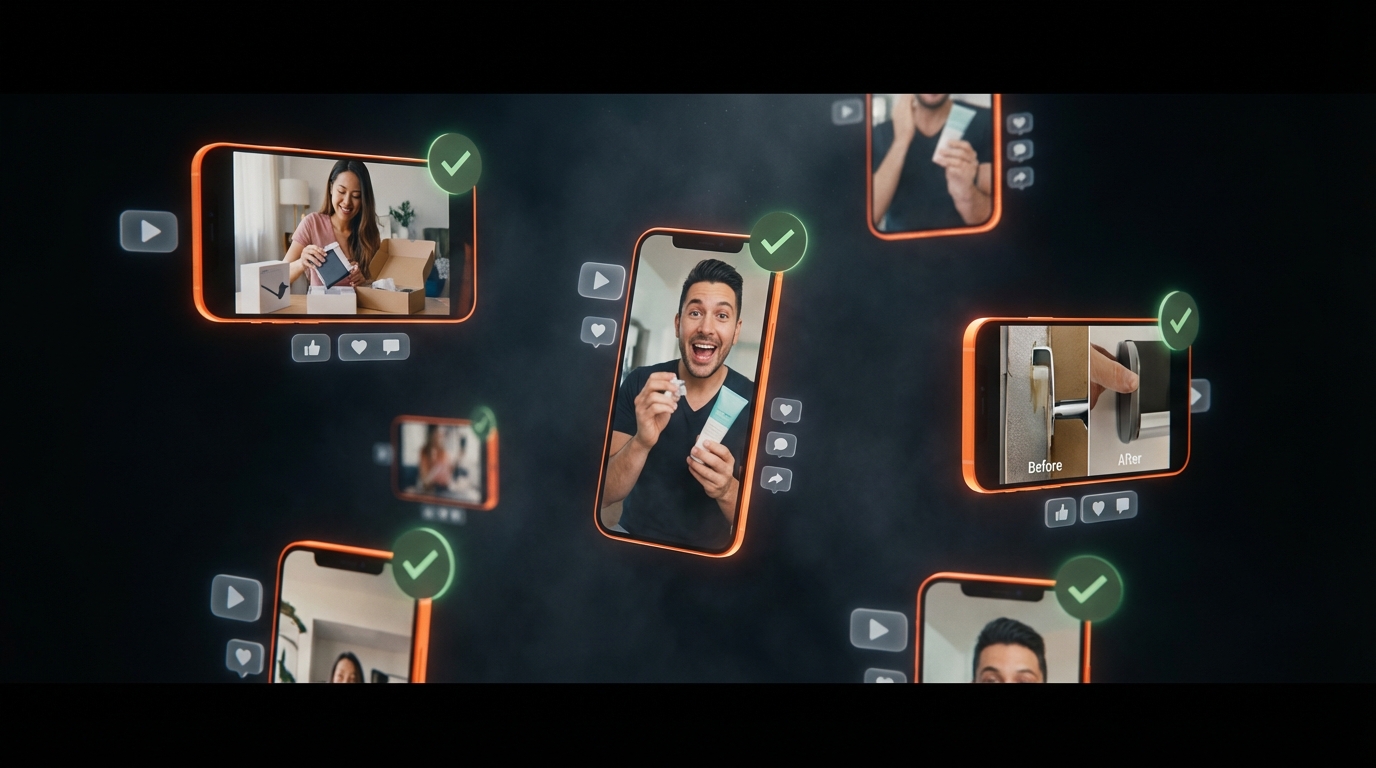
UGC isn’t a funnel-stage tactic. It’s a content production theme that works at every stage of the buyer journey. The angle changes based on what the brand needs to accomplish, but the format stays the same: real people, authentic delivery, native feel. A creator unboxing a product for the first time works for awareness. The same creator demonstrating the product and comparing it to alternatives works for education. A customer sharing their 3-month results works for conversion. The UGC format adapts to any objective.
What makes UGC particularly powerful for eCommerce is the economics. You can produce 10-20 UGC videos for the cost of a single studio shoot, which means you can test more angles, more hooks, and more creators at a pace that studio production can’t match. For brands trying to maintain the creative velocity that Meta rewards, UGC is the production method that scales. For the full creative strategy, see our Meta Ads creative guide.
Our finding: Across our managed eCommerce accounts, UGC ads consistently produce higher engagement rates and stronger nCAC than studio-produced content when run at equal spend. The advantage isn’t limited to cold prospecting. We see UGC testimonials outperform studio testimonials in retargeting, UGC product education outperform branded product demos in MOFU, and UGC reviews drive stronger conversion rates in BOFU. The format works because the trust transfer is real, regardless of where the viewer is in their buying decision.
How do you source UGC creators?
The creator you choose determines the audience segment your ad reaches. A 22-year-old creator reaches a different demographic than a 45-year-old creator, even with identical targeting. This is Andromeda doing its job: matching creative signals (including the person in the ad) to the users most likely to engage. But beyond targeting, you’re also tapping into something studio content can’t offer: the trust a creator has already built with their audience.
Where to find creators:
- Meta’s Creator Marketplace. Built directly into Meta Business Suite. Browse and connect with creators by niche, audience demographics, and content style. The advantage is that partnership ad setup and whitelisting are native to the platform, so there’s less friction between finding a creator and running ads under their handle
- UGC platforms (Billo, Insense, Clip). The fastest path for volume. Browse creator profiles, filter by niche and demographic, send briefs directly through the platform. Costs typically range from $100-300 per video depending on creator experience and deliverables
- Your own customers. The most authentic option. Reach out to customers who’ve left positive reviews or posted about your product organically. Offer product and a fee in exchange for ad-rights content. Customer-created UGC often outperforms professional UGC because the enthusiasm is genuine
- Micro-influencers (1K-50K followers). Many micro-influencers will create UGC-style content for $150-500 per video with full usage rights. Their content quality is often higher than platform creators because they’ve built an audience through strong content. And with whitelisting, you can run ads through their handle, leveraging the trust their followers already have
- In-house team. Your team members, founders, or employees can create effective UGC, especially for founder story and behind-the-scenes content. This works best for brands where the founder’s personality is part of the brand identity
Creator selection criteria:
| Factor | What to Look For | Why It Matters |
|---|---|---|
| Demographic match | Age, gender, and lifestyle that mirrors your target customer | Andromeda uses the creator’s appearance as a targeting signal |
| Natural delivery | Conversational, not scripted-sounding | Stiff delivery defeats the purpose of UGC |
| Content quality | Clean audio, decent lighting, steady framing | Low production quality hurts; “authentic” doesn’t mean “bad” |
| Reliability | Track record of delivering on time | Late content breaks your testing cadence |
| Existing audience | Engaged following in your product’s niche | Enables whitelisting with built-in trust |
The roster model: Don’t rely on a single creator. Maintain 3-5 active creators at all times and rotate new creators in monthly. Each creator fatigues just like each creative does. When audiences have seen enough content from one person, performance declines regardless of what they’re saying. Fresh faces extend your audience reach.
Our finding: The most expensive UGC mistake isn’t hiring the wrong creator. It’s hiring only one. If a creator’s content doesn’t perform, a brand may assume that UGC doesn’t work. But more often, the audience simply didn’t resonate with that particular creator. We’ve run campaigns with creators who have produced dozens of videos for the same brand and still perform well, because the audience-creator fit was strong from the start. The key is testing multiple creators early to find the ones your audience connects with, then investing in those relationships long-term while continuing to test new creators for incremental reach.
How should you run whitelisted UGC ads?
Whitelisting (also called creator licensing or partnership ads) lets you run paid ads through a creator’s Instagram or Facebook handle instead of (or alongside) your brand’s account. This is one of UGC’s biggest advantages over studio content, and most eCommerce brands underuse it.
Two whitelisting options:
- Creator-only ads. The ad appears to come entirely from the creator’s account. Users see the creator’s profile photo and handle, not your brand’s. This maximizes the native feel and taps directly into the trust the creator has with their audience. It works especially well when the creator has an engaged following in your product’s niche
- Joint brand-and-creator ads (partnership ads). The ad shows both the creator’s handle and your brand’s handle. This combines the creator’s authenticity with your brand’s credibility. It’s the stronger format for brands with established recognition, because users see both the social proof of the creator and the legitimacy of the brand
Setting up whitelisting:
- The creator grants your business partner access through Instagram’s branded content tools or Facebook’s Business Suite
- You create the ad in Ads Manager using the creator’s identity (or the partnership format)
- You control the targeting, budget, and optimization. The creator doesn’t need to do anything after granting access
Why whitelisting matters: Ads that run under a creator’s handle consistently see higher engagement rates than the same content run under a brand’s handle. The creator’s profile photo and name signal “person, not brand” in the feed, which earns the initial attention that brand accounts have to fight for.
How do you brief creators without killing authenticity?
The brief is where most UGC goes wrong. Brands either send a product and say “make a video about it” (too vague) or they write a word-for-word script the creator has to memorize (too rigid). Both approaches fail. Vague briefs produce generic content with no testable angle. Over-scripted briefs produce stiff content that defeats the purpose of UGC.
The right approach is somewhere in between: give creators the information they need to succeed, then let them deliver it in their own voice.
The 27Five UGC brief approach:
1. Brand and product context Give the creator everything they need to understand your product and why it matters. Key benefits, what makes it different from competitors, who it’s for, and what customers love most about it. Don’t assume the creator will research this on their own.
2. Proven hooks and talking points Instead of writing a specific script, provide a menu of options:
- 3-5 hooks that have performed well in previous content (with examples if you have them)
- Key talking points the content should cover (but not a rigid order they must follow)
- Examples of previous high-performing UGC from your brand or competitors, with notes on what made it work (strong hold rate, high conversion, etc.)
This gives creators the strategic direction they need while leaving room for their natural delivery. A creator who internalizes 3 strong talking points and chooses the hook that feels most natural to them will produce better content than a creator reading a 200-word script from behind the camera.
3. The angle (not the format) UGC is the theme. The angle fits what the brand needs to accomplish:
- Awareness angle: First impression, discovery, “I just found this”
- Education angle: How it works, why it’s different, comparison to alternatives
- Trust angle: Personal results, honest review, before-and-after
- Conversion angle: Why I keep rebuying, why it’s worth the price, limited-time offer
Tell the creator which angle you need, not how to execute it. They know how to talk to their audience better than you do.
4. Technical specs and anti-brief
- Film vertically (9:16 for Reels/Stories, crop-safe for 1:1 feed)
- Show the product within the first 5 seconds
- Natural lighting preferred
- What NOT to do: generic greetings (“Hey guys!”), brand jargon they wouldn’t naturally say, feature lists instead of benefits, teleprompter reading
5. Reference content Link to 2-3 existing ads (yours or competitors) that capture the energy and style you want. Highlight what specifically works about each reference: “Notice how she shows the product in the first 2 seconds” or “This hook drove a 35% hook rate.” Visual references with context eliminate more ambiguity than written instructions alone.
Our finding: The best UGC we’ve produced comes from creators who were given strong context (what the product does, what customers love, what hooks have worked before) and then trusted to deliver it their way. When we stopped scripting exact opening lines and instead shared a library of 5 proven hooks with performance data, creator content improved across the board. Creators picked the hooks that felt natural to their style, and the authenticity came through. The content converted better because it sounded like a real person, not a brand wearing a real person’s face.
How do you test UGC on Meta?
UGC follows the same testing framework as any other creative. The creator’s personality doesn’t change the methodology.
Testing structure:
- Launch in your manual testing campaign. Broad targeting, purchase objective, campaign budget optimization. Never launch untested UGC directly into your ASC scaling campaign
- Apply the 5x CPA rule. Each UGC ad gets budget equal to 5x your target CPA before you evaluate it. At a $30 CPA target, that’s $150 per ad. Below that threshold, the data isn’t statistically meaningful
- Evaluate on nCAC, not engagement. A UGC ad with thousands of likes but a $60 nCAC is a worse ad than one with 50 likes and a $25 nCAC. Engagement is encouraging; acquisition cost is what matters
- Graduate winners to ASC. Any UGC that performs at or below your target CPA after spending 5x moves to your scaling campaign. See our ASC playbook for the graduation process
What to test:
| Variable | How to Test | Why |
|---|---|---|
| Hook | Same creator, same body, different opening approach | Hook is the #1 performance driver |
| Creator | Same talking points, 2-3 different creators | Creator demographic = audience segment |
| Angle | Same creator, awareness angle vs. education angle vs. trust angle | Angle determines which buyer journey stage the ad serves |
| Format | Same message as UGC video vs. static vs. carousel | Format determines which users see the ad |
| Whitelisting | Same content run under creator handle vs. brand handle vs. partnership | Tests the trust transfer effect |
The hook-first testing approach: When a new batch of UGC arrives, don’t test everything at once. Test hooks first. Run the same body content with 3-5 different opening approaches and find the winning hook. Then test that winning hook with different creators and angles. This sequenced approach finds winners faster than testing all variables simultaneously.
How do you scale UGC production?
Scaling UGC isn’t about producing more of the same. It’s about building a system that consistently produces diverse, testable content at the velocity your spend requires.
Production cadence by spend level:
| Monthly Meta Spend | UGC Videos/Month | Active Creators | Brief Turnaround |
|---|---|---|---|
| $5K-15K | 8-12 | 2-3 | 1 brief/week |
| $15K-50K | 15-25 | 3-5 | 2 briefs/week |
| $50K-150K | 25-40 | 5-8 | 3-4 briefs/week |
| $150K+ | 40+ | 8-12 | Daily briefing |
The production pipeline:
- Monday: Review last week’s performance. Identify which hooks, creators, and angles produced winners. Feed these insights into new briefs, including sharing performance data with creators so they understand what’s working
- Tuesday: Write and send briefs. Each brief should test a specific hypothesis (new angle, new hook approach, new creator style)
- Week 1-2: Content creation. Creators produce and submit content. Review for angle alignment, not script compliance
- Editing (1-2 days). Add captions, trim to target length, create format variants (9:16, 1:1, 4:5). Some brands handle editing in-house; others have creators deliver final edits
- Launch day: Upload to testing campaign. Each new batch enters the testing campaign with broad targeting and the 5x CPA rule
Maintaining creative diversity:
Apply the 70/20/10 framework to your UGC production:
- 70% iterations: Take winning hooks and angles and reshoot with different creators, different settings, or slightly different talking points
- 20% new concepts: Test genuinely new angles, value propositions, or content approaches you haven’t tried
- 10% wild swings: Let a creator go completely off-brief, try a trending format, or test an unconventional approach. Some of the best-performing UGC we’ve seen came from creators who ignored the brief and did something unexpected
For how UGC fits into the broader creative strategy alongside static, carousel, and produced video, see our creative guide. For the scaling framework that connects creative velocity to budget increases, see our scaling guide.
Frequently Asked Questions
How much should I pay UGC creators?
Expect $100-300 per video through UGC platforms (Billo, Insense, Clip) and $200-500 per video for micro-influencers providing ad-rights content. Pricing varies by creator experience, deliverable complexity, and usage rights. Always negotiate full ad-rights ownership so you can use the content across all placements indefinitely. Per-video pricing is more predictable than retainer arrangements for most eCommerce brands.
How long should UGC videos be for Meta Ads?
15-30 seconds for awareness and discovery angles. Long enough to deliver a hook, show the product, and include a CTA. Under 15 seconds rarely provides enough context. Over 45 seconds and you lose most cold viewers. For education and trust angles (detailed reviews, tutorials, comparisons), 30-60 seconds works because the viewer is already interested in learning more.
Does UGC only work for top-of-funnel?
No. UGC works across the entire buyer journey. The format (real person, native feel) stays the same; the angle changes. Awareness angles introduce the product to new audiences. Education angles teach engaged audiences why it’s worth buying. Trust angles (reviews, results, comparisons) help persuade purchase over competitors. UGC is the production method. The angle fits the brand’s objective.
How do I know when a UGC creator has fatigued?
Watch for the same signals as any creative fatigue: hook rate declining below 25%, frequency rising above 2.5, and CPA trending upward on that creator’s content. Even great creators fatigue. When you notice the signals, rotate in a new creator with fresh content rather than asking the same creator to reshoot similar material.
Can AI-generated UGC replace real creators?
Not yet. AI-generated faces and voices are detectable by most users, and Meta’s policies require disclosure of AI-generated content. More importantly, authenticity is the entire point of UGC. The format works because viewers believe a real person is sharing a real experience. AI UGC undermines that trust. Use AI for ideation, scriptwriting, and editing assistance, but keep real humans in front of the camera.
What to Read Next
- Meta Ads for eCommerce: The Complete Guide (2026) — The full strategic framework including campaign architecture, creative, and scaling
- Meta Ads Creative for eCommerce: What Actually Works in 2026 — How UGC fits alongside static, carousel, and produced video formats
- How to Build a Meta Ads Creative Testing System for eCommerce — The testing methodology and 5x CPA rule for evaluating UGC winners
- How to Scale Meta Ads for eCommerce Without Killing Your ROAS — How creative velocity (including UGC production) connects to budget scaling